> ## Documentation Index
> Fetch the complete documentation index at: https://bifrost-dev.mintlify.site/llms.txt
> Use this file to discover all available pages before exploring further.
# OpenRouter
> OpenRouter API conversion guide - routing to multiple providers, reasoning support, parameter handling, and streaming
## Overview
OpenRouter is an **OpenAI-compatible provider routing service** that accesses models from multiple providers (OpenAI, Anthropic, Google, Meta, etc.) through a unified interface. Bifrost delegates to the OpenAI implementation with special handling for reasoning models. Key features:
* **Provider aggregation** - Access 100+ models from multiple vendors
* **Reasoning support** - Extended thinking for supported models
* **Parameter compatibility** - Intelligent reasoning effort conversion
* **Streaming support** - Full SSE support with usage tracking
* **Tool calling** - Complete function definition and execution
### Supported Operations
| Operation | Non-Streaming | Streaming | Endpoint |
| -------------------- | ------------- | --------- | -------------------------- |
| Chat Completions | ✅ | ✅ | `/v1/chat/completions` |
| Responses API | ✅ | ✅ | `/v1/responses` |
| Text Completions | ✅ | ✅ | `/v1/completions` |
| List Models | ✅ | - | `/v1/models` |
| Embeddings | ✅ | - | `/v1/embeddings` |
| Speech (TTS) | ✅ | ❌ | `/v1/audio/speech` |
| Transcriptions (STT) | ✅ | ❌ | `/v1/audio/transcriptions` |
| Image Generation | ❌ | ❌ | - |
| Files | ❌ | ❌ | - |
| Batch | ❌ | ❌ | - |
**Unsupported Operations** (❌): Image Generation, Files, Batch, and streaming Speech/Transcriptions are not supported by the upstream OpenRouter API. These return a `BifrostError` with an error code of `"unsupported_operation"`.
**Note**: OpenRouter's Responses API is currently in **beta**.
## Setup & Configuration
Configure OpenRouter as a provider.
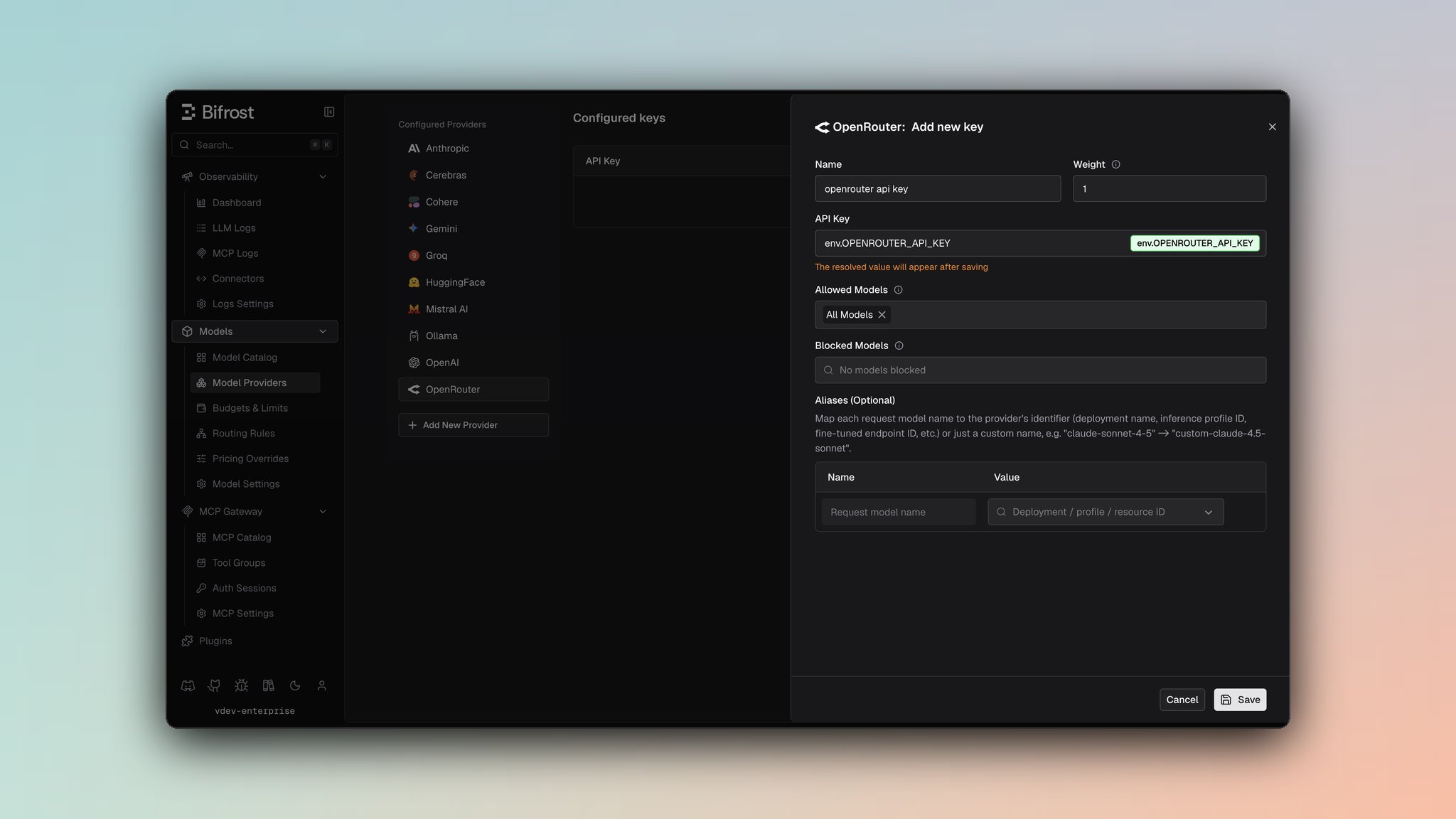 1. Navigate to **Models** > **Model Providers**. Look for **OpenRouter** under **Configured Providers**. If it is missing, click on **Add New Provider** and select **OpenRouter**.
2. Click **Add Key** or edit an existing key.
3. Set a name for your key.
4. Paste your API key directly or use an environment variable (for example, `env.OPENROUTER_API_KEY`).
5. Set **Allowed Models** to **All Models** (default) or the specific model allowlist you want this key to serve.
6. Save the provider configuration.
```json theme={null}
{
"providers": {
"openrouter": {
"keys": [
{
"name": "openrouter-key-1",
"value": "env.OPENROUTER_API_KEY",
"models": [
"*"
],
"weight": 1.0
}
]
}
}
}
```
Refer to the API documentation for [Provider Keys Management](https://docs.getbifrost.ai/api-reference/providers/create-a-key-for-a-provider).
```go theme={null}
case schemas.OpenRouter:
return []schemas.Key{{
Name: "openrouter-key-1",
Value: *schemas.NewSecretVar("env.OPENROUTER_API_KEY"),
Models: []string{"*"},
Weight: 1.0,
}}, nil
```
OpenRouter key validation uses `/v1/auth/key` when provider key validation is enabled.
***
# 1. Chat Completions
## Request Parameters
OpenRouter supports all standard OpenAI chat completion parameters. For full parameter reference and behavior, see [OpenAI Chat Completions](/providers/supported-providers/openai#1-chat-completions).
### Reasoning Parameter Handling
OpenRouter supports extended thinking on compatible models:
```json theme={null}
// Bifrost request
{
"reasoning": {
"effort": "high",
"max_tokens": 10000
}
}
// OpenRouter conversion
{
"reasoning_effort": "high"
}
```
**Reasoning Models:** gpt-oss-120b and compatible models with special handling for reasoning content.
### Cache Control Stripping
Anthropic-specific cache control directives are automatically removed:
```go theme={null}
// Bifrost supports cache control from Anthropic
{
"messages": [{
"role": "user",
"content": [{
"type": "text",
"text": "...",
"cache_control": {"type": "ephemeral"} // ← Stripped
}]
}]
}
// Sent to OpenRouter without cache directives
```
### Filtered Parameters
Removed for OpenRouter compatibility:
* `prompt_cache_key` - Not supported
* `verbosity` - Anthropic-specific
* `store` - Not supported
* `service_tier` - OpenAI-specific
OpenRouter supports all standard OpenAI message types, tools, responses, and streaming formats. For details on message handling, tool conversion, responses, and streaming, refer to [OpenAI Chat Completions](/providers/supported-providers/openai#1-chat-completions).
***
# 2. Responses API
OpenRouter's Responses API is handled as a distinct endpoint at `/v1/responses`. This API is currently in **beta** on OpenRouter.
Same parameter support as Chat Completions, with requests forwarded directly to the Responses API endpoint without conversion to Chat Completions.
**Special Message Handling (gpt-oss vs other models):**
For details on how reasoning is handled differently between gpt-oss and other models, see [OpenAI Responses API documentation](/providers/supported-providers/openai) for the comprehensive explanation of reasoning conversion (summaries vs. content blocks).
***
# 3. Text Completions
OpenRouter supports legacy text completion format:
| Parameter | Mapping |
| ---------------------- | ------------------- |
| `prompt` | Direct pass-through |
| `max_tokens` | max\_tokens |
| `temperature`, `top_p` | Direct pass-through |
| `stop` | Stop sequences |
***
# 4. List Models
Lists 100+ models available through OpenRouter, including:
* OpenAI (GPT-4, GPT-4 Turbo, etc.)
* Anthropic (Claude 3 family)
* Google (Gemini)
* Meta (Llama)
* Mistral
* And many more
***
# 5. Embeddings
OpenRouter supports embeddings through their OpenAI-compatible API. This allows you to generate vector embeddings for text using models from various providers.
| Parameter | Mapping |
| ----------------- | -------------------------------------------------------------------------------- |
| `input` | Direct pass-through (string or array of strings) |
| `model` | Model ID (e.g., `cohere/embed-multilingual-v3.0`, `amazon/amazon-embeddings-v2`) |
| `dimensions` | Number of dimensions for the output embedding |
| `encoding_format` | Output format (`float` or `base64`) |
**Supported Models:** OpenRouter supports various embedding models including:
* Cohere (embed-multilingual-v3.0, embed-english-v3.0, etc.)
* Amazon (amazon-embeddings-v2)
* And other providers
The embedding request/response follows the standard OpenAI format.
***
## Speech (TTS) & Transcription (STT)
Speech and Transcription support for OpenRouter is available in **Bifrost v2.0.0 and above**.
OpenRouter exposes OpenAI-compatible audio endpoints, so Bifrost routes Speech and Transcription requests the same way it does for OpenAI: `/v1/audio/speech` for text-to-speech and `/v1/audio/transcriptions` for speech-to-text.
| Parameter | Mapping |
| ----------------- | -------------------------------------------------------------------------------------------- |
| `model` | TTS/STT model ID (e.g., `openai/gpt-4o-mini-tts`, `openai/whisper-1`) |
| `voice` | Required for Speech; voice availability depends on the underlying model |
| `response_format` | Speech: `mp3` or `pcm` (`pcm` if omitted). Transcription: `json` (default) or `verbose_json` |
| `speed` | Optional playback speed multiplier for Speech (provider-dependent) |
| `language` | Optional ISO-639-1 code for Transcription; auto-detected if omitted |
Streaming Speech and Transcription are not supported by the upstream OpenRouter API and return a `BifrostError` with `"unsupported_operation"`.
***
## Unsupported Features
| Feature | Reason |
| --------------------------- | ----------------------------- |
| Image Generation | Not offered by OpenRouter API |
| Streaming Speech/TTS | Not offered by OpenRouter API |
| Streaming Transcription/STT | Not offered by OpenRouter API |
| Batch Operations | Not offered by OpenRouter API |
| File Management | Not offered by OpenRouter API |
***
## Caveats
**Severity**: Medium
**Behavior**: Anthropic cache control directives are removed
**Impact**: Prompt caching features unavailable
**Code**: Stripped during JSON marshaling
**Severity**: Low
**Behavior**: OpenAI-specific parameters filtered
**Impact**: prompt\_cache\_key, verbosity, store removed
**Code**: filterOpenAISpecificParameters
**Severity**: Low
**Behavior**: User field > 64 characters silently dropped
**Impact**: Longer user identifiers are lost
**Code**: SanitizeUserField enforces 64-char max
1. Navigate to **Models** > **Model Providers**. Look for **OpenRouter** under **Configured Providers**. If it is missing, click on **Add New Provider** and select **OpenRouter**.
2. Click **Add Key** or edit an existing key.
3. Set a name for your key.
4. Paste your API key directly or use an environment variable (for example, `env.OPENROUTER_API_KEY`).
5. Set **Allowed Models** to **All Models** (default) or the specific model allowlist you want this key to serve.
6. Save the provider configuration.
```json theme={null}
{
"providers": {
"openrouter": {
"keys": [
{
"name": "openrouter-key-1",
"value": "env.OPENROUTER_API_KEY",
"models": [
"*"
],
"weight": 1.0
}
]
}
}
}
```
Refer to the API documentation for [Provider Keys Management](https://docs.getbifrost.ai/api-reference/providers/create-a-key-for-a-provider).
```go theme={null}
case schemas.OpenRouter:
return []schemas.Key{{
Name: "openrouter-key-1",
Value: *schemas.NewSecretVar("env.OPENROUTER_API_KEY"),
Models: []string{"*"},
Weight: 1.0,
}}, nil
```
OpenRouter key validation uses `/v1/auth/key` when provider key validation is enabled.
***
# 1. Chat Completions
## Request Parameters
OpenRouter supports all standard OpenAI chat completion parameters. For full parameter reference and behavior, see [OpenAI Chat Completions](/providers/supported-providers/openai#1-chat-completions).
### Reasoning Parameter Handling
OpenRouter supports extended thinking on compatible models:
```json theme={null}
// Bifrost request
{
"reasoning": {
"effort": "high",
"max_tokens": 10000
}
}
// OpenRouter conversion
{
"reasoning_effort": "high"
}
```
**Reasoning Models:** gpt-oss-120b and compatible models with special handling for reasoning content.
### Cache Control Stripping
Anthropic-specific cache control directives are automatically removed:
```go theme={null}
// Bifrost supports cache control from Anthropic
{
"messages": [{
"role": "user",
"content": [{
"type": "text",
"text": "...",
"cache_control": {"type": "ephemeral"} // ← Stripped
}]
}]
}
// Sent to OpenRouter without cache directives
```
### Filtered Parameters
Removed for OpenRouter compatibility:
* `prompt_cache_key` - Not supported
* `verbosity` - Anthropic-specific
* `store` - Not supported
* `service_tier` - OpenAI-specific
OpenRouter supports all standard OpenAI message types, tools, responses, and streaming formats. For details on message handling, tool conversion, responses, and streaming, refer to [OpenAI Chat Completions](/providers/supported-providers/openai#1-chat-completions).
***
# 2. Responses API
OpenRouter's Responses API is handled as a distinct endpoint at `/v1/responses`. This API is currently in **beta** on OpenRouter.
Same parameter support as Chat Completions, with requests forwarded directly to the Responses API endpoint without conversion to Chat Completions.
**Special Message Handling (gpt-oss vs other models):**
For details on how reasoning is handled differently between gpt-oss and other models, see [OpenAI Responses API documentation](/providers/supported-providers/openai) for the comprehensive explanation of reasoning conversion (summaries vs. content blocks).
***
# 3. Text Completions
OpenRouter supports legacy text completion format:
| Parameter | Mapping |
| ---------------------- | ------------------- |
| `prompt` | Direct pass-through |
| `max_tokens` | max\_tokens |
| `temperature`, `top_p` | Direct pass-through |
| `stop` | Stop sequences |
***
# 4. List Models
Lists 100+ models available through OpenRouter, including:
* OpenAI (GPT-4, GPT-4 Turbo, etc.)
* Anthropic (Claude 3 family)
* Google (Gemini)
* Meta (Llama)
* Mistral
* And many more
***
# 5. Embeddings
OpenRouter supports embeddings through their OpenAI-compatible API. This allows you to generate vector embeddings for text using models from various providers.
| Parameter | Mapping |
| ----------------- | -------------------------------------------------------------------------------- |
| `input` | Direct pass-through (string or array of strings) |
| `model` | Model ID (e.g., `cohere/embed-multilingual-v3.0`, `amazon/amazon-embeddings-v2`) |
| `dimensions` | Number of dimensions for the output embedding |
| `encoding_format` | Output format (`float` or `base64`) |
**Supported Models:** OpenRouter supports various embedding models including:
* Cohere (embed-multilingual-v3.0, embed-english-v3.0, etc.)
* Amazon (amazon-embeddings-v2)
* And other providers
The embedding request/response follows the standard OpenAI format.
***
## Speech (TTS) & Transcription (STT)
Speech and Transcription support for OpenRouter is available in **Bifrost v2.0.0 and above**.
OpenRouter exposes OpenAI-compatible audio endpoints, so Bifrost routes Speech and Transcription requests the same way it does for OpenAI: `/v1/audio/speech` for text-to-speech and `/v1/audio/transcriptions` for speech-to-text.
| Parameter | Mapping |
| ----------------- | -------------------------------------------------------------------------------------------- |
| `model` | TTS/STT model ID (e.g., `openai/gpt-4o-mini-tts`, `openai/whisper-1`) |
| `voice` | Required for Speech; voice availability depends on the underlying model |
| `response_format` | Speech: `mp3` or `pcm` (`pcm` if omitted). Transcription: `json` (default) or `verbose_json` |
| `speed` | Optional playback speed multiplier for Speech (provider-dependent) |
| `language` | Optional ISO-639-1 code for Transcription; auto-detected if omitted |
Streaming Speech and Transcription are not supported by the upstream OpenRouter API and return a `BifrostError` with `"unsupported_operation"`.
***
## Unsupported Features
| Feature | Reason |
| --------------------------- | ----------------------------- |
| Image Generation | Not offered by OpenRouter API |
| Streaming Speech/TTS | Not offered by OpenRouter API |
| Streaming Transcription/STT | Not offered by OpenRouter API |
| Batch Operations | Not offered by OpenRouter API |
| File Management | Not offered by OpenRouter API |
***
## Caveats
**Severity**: Medium
**Behavior**: Anthropic cache control directives are removed
**Impact**: Prompt caching features unavailable
**Code**: Stripped during JSON marshaling
**Severity**: Low
**Behavior**: OpenAI-specific parameters filtered
**Impact**: prompt\_cache\_key, verbosity, store removed
**Code**: filterOpenAISpecificParameters
**Severity**: Low
**Behavior**: User field > 64 characters silently dropped
**Impact**: Longer user identifiers are lost
**Code**: SanitizeUserField enforces 64-char max