> ## Documentation Index
> Fetch the complete documentation index at: https://bifrost-dev.mintlify.site/llms.txt
> Use this file to discover all available pages before exploring further.
# Singulr AI
> Use Singulr AI policies with Bifrost Enterprise to block unsafe LLM traffic and apply policy-selected PII redaction.
## Overview
Bifrost Enterprise supports **Singulr AI** as a third-party guardrail provider for LLM requests and responses.
Singulr owns the policies and their decisions. Configure prompt-injection, PII, PHI, or other policies in Singulr, then attach the Singulr profile to a Bifrost rule to choose which traffic is evaluated. Singulr returns an `allow`, `block`, or `redact` decision; Bifrost enforces it inline.
* **Allow:** Bifrost continues the request or response unchanged.
* **Block:** Bifrost returns a guardrail intervention and does not continue that phase.
* **Redact:** Singulr returns entity spans. Bifrost validates those spans, replaces the matching runtime text, and persists the redacted values in Bifrost logs.
Singulr selects whether a policy allows, blocks, or redacts. The Singulr profile does not expose a separate Bifrost `action`, `redaction_strategy`, or `redaction_mode` setting. Its redaction behavior is fixed to runtime replacement after Bifrost validates the spans returned by Singulr.
**Streaming output:** For `output` and `both` rules, Bifrost holds the response until generation is complete, evaluates the complete response with Singulr once, then releases the allowed/redacted response or returns a guardrail intervention. It does not send individual stream chunks to Singulr.
## Prerequisites
* Bifrost Enterprise with guardrails enabled
* A Singulr API key
* A Singulr Application ID and Guardrail ID for the application/policy you want to enforce
* Required policies enabled in Singulr for the selected guardrail
* Network egress from Bifrost to the Singulr API over HTTPS
## Set Up Policies in Singulr
Before creating the Bifrost profile:
1. Create or select the Singulr application that represents the workload you want to protect.
2. Create or select its guardrail configuration.
3. Enable the required Singulr policies, such as prompt injection, PII, or PHI.
4. Configure each policy's decision in Singulr: allow, block, or redact.
5. Copy the API key, complete Application ID, and Guardrail ID into Bifrost.
The Application ID is the complete bracketed value supplied by Singulr. Keep separate Singulr applications and guardrail IDs for environments that need independent policy changes.
## How It Works
1. Create a Bifrost provider configuration with `provider_name: "singulr-ai"`.
2. Attach it to a guardrail rule that applies to `input`, `output`, or `both`.
3. Bifrost sends the selected conversation to Singulr before the LLM call, or sends the completed assistant response after the call.
4. Singulr evaluates the applicable policies and returns `allow`, `block`, or `redact`.
5. Bifrost maps that decision to the request or response path.
For an output evaluation, Bifrost sends prior conversation context in `messages` and the final assistant output in a separate `response` object. Singulr uses the context for evaluation, but Bifrost only permits redaction of the final assistant response.
## Configuration Fields
| Field | Type | Required | Default | Description |
| ---------------- | ------- | -------- | ----------------------------------------- | ------------------------------------------------------------------------------------------------ |
| `api_key` | string | Yes | - | Singulr API key. Supports `env.SINGULR_API_KEY`. |
| `application_id` | string | Yes | - | Complete Application ID supplied by Singulr. |
| `guardrail_id` | string | Yes | - | Guardrail configuration ID supplied by Singulr. |
| `base_url` | string | No | `https://dev-app6.ai-platform.singulr.ai` | Singulr API root. Bifrost appends `/api/v1/ai-gateway/bifrost`. Supports `env.SINGULR_BASE_URL`. |
| `timeout` | integer | No | `30` | Provider execution timeout in seconds. |
## Configure Bifrost
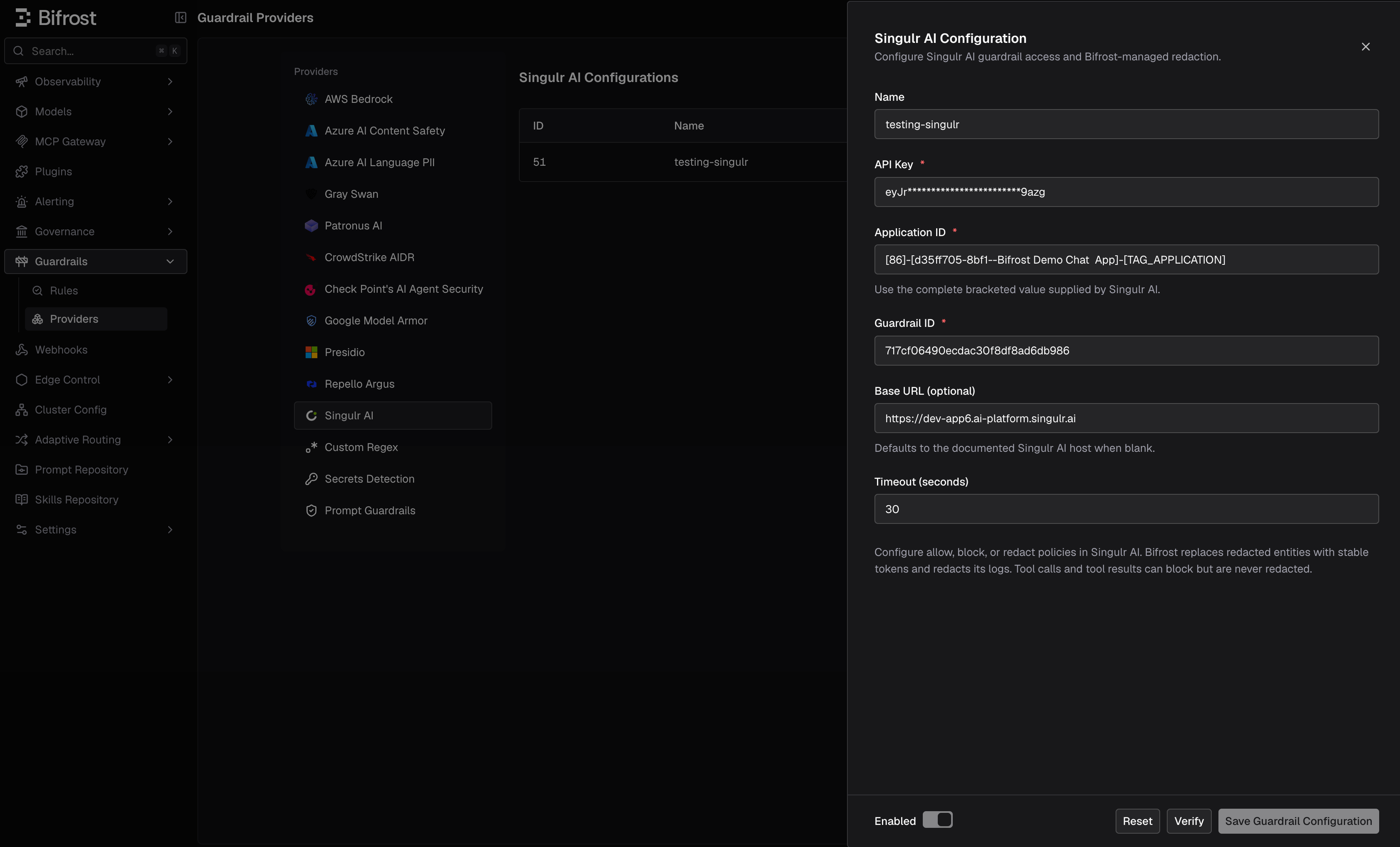
1. Go to **Guardrails** > **Providers**.
2. Select **Singulr AI** and click **Add Configuration**.
3. Enter a descriptive **Name**.
4. Enter the **API Key**, complete **Application ID**, and **Guardrail ID** supplied by Singulr.
5. Leave **Base URL** blank to use the default Singulr API root, unless Singulr has provided a different endpoint.
6. Set the timeout, enable the configuration, optionally click **Verify**, then save it.
7. Under **Guardrails** > **Rules**, attach the saved Singulr profile to an input, output, or both-phase rule.
 Create the Singulr AI provider configuration with the management API:
```bash theme={null}
curl -X POST http://localhost:8080/api/guardrails/singulr-ai \
-H "Content-Type: application/json" \
-d '{
"name": "singulr-ai-production",
"enabled": true,
"config": {
"api_key": "env.SINGULR_API_KEY",
"application_id": "[APPLICATION_ID]",
"guardrail_id": "guardrail-1234567890",
"base_url": "env.SINGULR_BASE_URL",
"timeout": 30
}
}'
```
Fetch the generated configuration ID:
```bash theme={null}
curl -X GET http://localhost:8080/api/guardrails/singulr-ai
```
Attach it to a rule by referencing `singulr-ai:` in `selectedGuardrailProfiles`:
```bash theme={null}
curl -X POST http://localhost:8080/api/guardrails/rules \
-H "Content-Type: application/json" \
-d '{
"name": "singulr-ai-all-traffic",
"description": "Apply Singulr AI policies to prompts and completions",
"enabled": true,
"celExpression": "provider == \"openai\"",
"applyTo": "both",
"samplingRate": 100,
"timeout": 60,
"selectedGuardrailProfiles": ["singulr-ai:25"]
}'
```
```json theme={null}
{
"guardrails_config": {
"guardrail_providers": [
{
"id": 25,
"provider_name": "singulr-ai",
"policy_name": "singulr-ai-production",
"enabled": true,
"timeout": 30,
"config": {
"api_key": "env.SINGULR_API_KEY",
"application_id": "[APPLICATION_ID]",
"guardrail_id": "guardrail-1234567890",
"base_url": "env.SINGULR_BASE_URL"
}
}
],
"guardrail_rules": [
{
"id": 251,
"name": "singulr-ai-all-traffic",
"description": "Apply Singulr AI policies to prompts and completions",
"enabled": true,
"cel_expression": "provider == 'openai'",
"apply_to": "both",
"sampling_rate": 100,
"timeout": 60,
"provider_config_ids": [25]
}
]
}
}
```
```yaml theme={null}
bifrost:
guardrails:
providers:
- id: 25
provider_name: "singulr-ai"
policy_name: "singulr-ai-production"
enabled: true
timeout: 30
config:
api_key: "env.SINGULR_API_KEY"
application_id: "[APPLICATION_ID]"
guardrail_id: "guardrail-1234567890"
base_url: "env.SINGULR_BASE_URL"
rules:
- id: 251
name: "singulr-ai-all-traffic"
description: "Apply Singulr AI policies to prompts and completions"
enabled: true
cel_expression: "provider == 'openai'"
apply_to: "both"
sampling_rate: 100
timeout: 60
provider_config_ids: [25]
```
## Supported Content and Limitations
* **LLM input and output:** Singulr evaluates text-bearing request and response content. Input redaction targets the current message; output redaction targets the final assistant response.
* **Conversation context:** Bifrost can include prior conversation when evaluating input or output. Prior turns provide context but are not redaction targets.
* **Tool calls and tool results:** Singulr can block content in tool-call arguments and tool-result content, but Bifrost does not redact those fields with Singulr spans.
* **Images and files:** This integration sends text content, not image pixels, file bytes, or arbitrary binary payloads.
For shared rule behavior, CEL scoping, streaming replay, and audit logging, see [Guardrails](/enterprise/guardrails). For the general redaction model, see [Guardrail Redaction](/enterprise/guardrails/redaction).
Create the Singulr AI provider configuration with the management API:
```bash theme={null}
curl -X POST http://localhost:8080/api/guardrails/singulr-ai \
-H "Content-Type: application/json" \
-d '{
"name": "singulr-ai-production",
"enabled": true,
"config": {
"api_key": "env.SINGULR_API_KEY",
"application_id": "[APPLICATION_ID]",
"guardrail_id": "guardrail-1234567890",
"base_url": "env.SINGULR_BASE_URL",
"timeout": 30
}
}'
```
Fetch the generated configuration ID:
```bash theme={null}
curl -X GET http://localhost:8080/api/guardrails/singulr-ai
```
Attach it to a rule by referencing `singulr-ai:` in `selectedGuardrailProfiles`:
```bash theme={null}
curl -X POST http://localhost:8080/api/guardrails/rules \
-H "Content-Type: application/json" \
-d '{
"name": "singulr-ai-all-traffic",
"description": "Apply Singulr AI policies to prompts and completions",
"enabled": true,
"celExpression": "provider == \"openai\"",
"applyTo": "both",
"samplingRate": 100,
"timeout": 60,
"selectedGuardrailProfiles": ["singulr-ai:25"]
}'
```
```json theme={null}
{
"guardrails_config": {
"guardrail_providers": [
{
"id": 25,
"provider_name": "singulr-ai",
"policy_name": "singulr-ai-production",
"enabled": true,
"timeout": 30,
"config": {
"api_key": "env.SINGULR_API_KEY",
"application_id": "[APPLICATION_ID]",
"guardrail_id": "guardrail-1234567890",
"base_url": "env.SINGULR_BASE_URL"
}
}
],
"guardrail_rules": [
{
"id": 251,
"name": "singulr-ai-all-traffic",
"description": "Apply Singulr AI policies to prompts and completions",
"enabled": true,
"cel_expression": "provider == 'openai'",
"apply_to": "both",
"sampling_rate": 100,
"timeout": 60,
"provider_config_ids": [25]
}
]
}
}
```
```yaml theme={null}
bifrost:
guardrails:
providers:
- id: 25
provider_name: "singulr-ai"
policy_name: "singulr-ai-production"
enabled: true
timeout: 30
config:
api_key: "env.SINGULR_API_KEY"
application_id: "[APPLICATION_ID]"
guardrail_id: "guardrail-1234567890"
base_url: "env.SINGULR_BASE_URL"
rules:
- id: 251
name: "singulr-ai-all-traffic"
description: "Apply Singulr AI policies to prompts and completions"
enabled: true
cel_expression: "provider == 'openai'"
apply_to: "both"
sampling_rate: 100
timeout: 60
provider_config_ids: [25]
```
## Supported Content and Limitations
* **LLM input and output:** Singulr evaluates text-bearing request and response content. Input redaction targets the current message; output redaction targets the final assistant response.
* **Conversation context:** Bifrost can include prior conversation when evaluating input or output. Prior turns provide context but are not redaction targets.
* **Tool calls and tool results:** Singulr can block content in tool-call arguments and tool-result content, but Bifrost does not redact those fields with Singulr spans.
* **Images and files:** This integration sends text content, not image pixels, file bytes, or arbitrary binary payloads.
For shared rule behavior, CEL scoping, streaming replay, and audit logging, see [Guardrails](/enterprise/guardrails). For the general redaction model, see [Guardrail Redaction](/enterprise/guardrails/redaction).